The Law, Ethics, and the Ongoing National Conversation
Medical Assistance in Dying (MAID) has become one of the most significant and debated developments in Canadian healthcare, law, and ethics over the past decade. Introduced to provide an option for individuals suffering intolerably at the end of life, MAID has since expanded in scope and complexity, raising profound questions about autonomy, compassion, disability rights, mental health, and the role of medicine. Today, MAID sits at the intersection of personal choice and public responsibility, making it one of the most closely examined medical policies in the country.
What Is MAID?
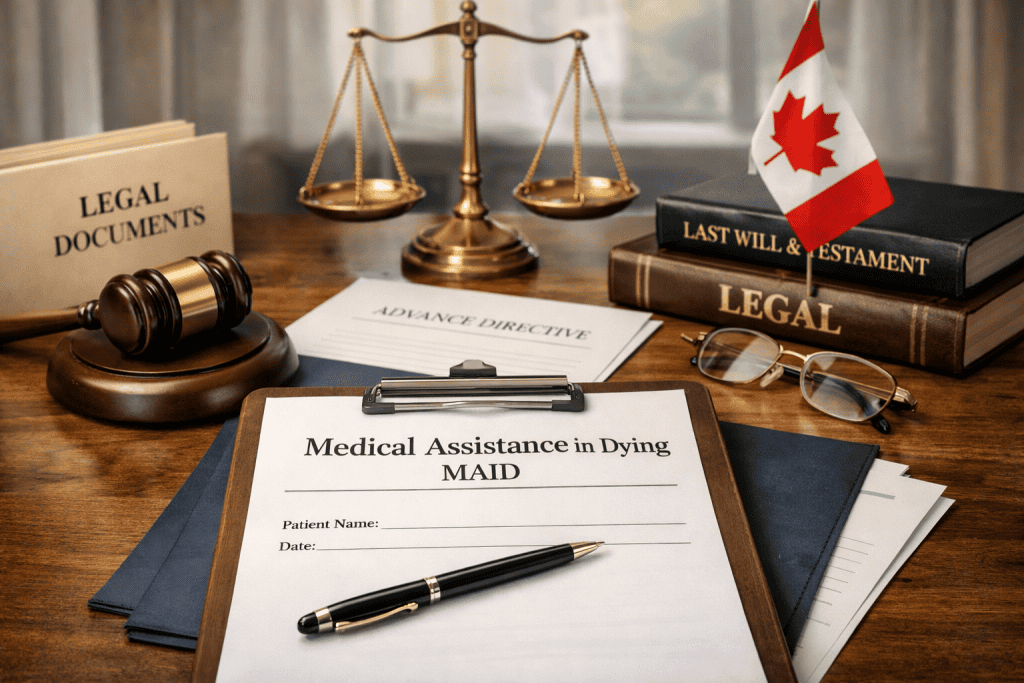
Medical Assistance in Dying (MAID) refers to a medical process in which a physician or nurse practitioner legally provides or administers medication that causes a patient’s death, at the patient’s voluntary and informed request. In Canada, MAID can be provided in two ways:
- Clinician-administered MAID – where the practitioner administers medication intravenously.
- Self-administered MAID – where the patient takes prescribed medication themselves (less common in practice).
MAID is distinct from palliative sedation and withdrawal of life support. Its defining characteristic is that the primary intention is to bring about death to relieve suffering, under strict legal conditions.
Legal Origins of MAID in Canada: Carter v. Canada

MAID became legal in Canada following the landmark 2015 Supreme Court ruling Carter v. Canada, which struck down the federal prohibition on assisted dying. The Court ruled that the ban violated the Canadian Charter of Rights and Freedoms by denying individuals autonomy and forcing them to endure intolerable suffering.
In response, the federal government passed Bill C-14 in 2016, formally legalizing MAID under specific eligibility criteria. At the time, MAID was limited primarily to individuals whose natural death was “reasonably foreseeable.”
The Expansion of Eligibility & Access to MAID Across Canada
In 2021, Bill C-7 significantly expanded access to MAID following a Quebec court ruling that found the “reasonably foreseeable death” requirement unconstitutional. This created two distinct pathways:
- Track 1: For individuals whose natural death is reasonably foreseeable.
- Track 2: For individuals with serious and incurable illnesses or disabilities whose death is not reasonably foreseeable.
Track 2 introduced additional safeguards, including longer assessment periods and specialist consultations.
One of the most controversial aspects of Bill C-7 was the decision to eventually allow MAID for individuals whose sole underlying condition is a mental illness. This provision has been repeatedly delayed amid widespread concern from psychiatrists, disability advocates, and provincial governments. As of now, Canada continues to postpone this expansion while reassessing safeguards and readiness.
Eligibility Criteria: Who Qualifies?

To qualify for MAID in Canada, an individual must generally:
- Be eligible for publicly funded healthcare in Canada
- Be at least 18 years old and capable of making healthcare decisions
- Have a grievous and irremediable medical condition
- Make a voluntary request free from external pressure
- Provide informed consent after being advised of alternatives, including palliative care
A “grievous and irremediable medical condition” includes a serious and incurable illness, irreversible decline, enduring suffering, and—depending on the track—either a foreseeable death or extensive safeguards.
Note: Visitors to Canada are not eligible for medical assistance in dying. This prevents MAID being subject to any “MAID tourism”.
How MAID Is Accessed: The Process & Approval
Patients typically begin the MAID process by speaking with a physician, nurse practitioner, or MAID coordination service. Two independent clinicians must assess eligibility. Once approved, MAID may be provided in hospitals, hospices, long-term care facilities, or private homes.
Provincial healthcare systems manage MAID delivery differently, but it is publicly funded across Canada. Unlike some countries, there is no direct cost to the patient.
Ethical and Social Debates about MAID in Canada

MAID has sparked intense ethical debate across Canada.
Supporters argue that MAID:
- Respects personal autonomy and dignity
- Prevents prolonged and unbearable suffering
- Provides compassionate choice at the end of life
- Aligns with modern patient-centered healthcare values
Critics, including many disability rights organizations, warn that MAID:
- Risks of normalizing death as a solution to suffering
- May disproportionately affect vulnerable populations
- Could substitute for inadequate access to disability support, housing, or palliative care
- Raises concerns about subtle coercion or systemic pressure
The debate intensified as MAID cases increasingly involved individuals with chronic disabilities rather than terminal illnesses. Critics argue that social determinants—poverty, isolation, lack of services—can blur the line between a free choice and a constrained one.
MAID vs. Palliative Care

A central issue in the MAID discussion is the relationship between assisted dying and palliative care. While Canadian law requires that patients be informed of palliative options, access to high-quality palliative care remains uneven across regions.
Many healthcare professionals emphasize that MAID should never replace robust palliative care. Others note that even the best palliative care cannot relieve all suffering, particularly existential or psychological distress. The challenge lies in ensuring that MAID exists alongside—not instead of—comprehensive end-of-life support.
International Context: Canada as a ‘progressive’ example of dignity in death & Right to Die
Canada is often cited as having one of the most permissive assisted dying regimes in the world. Compared with countries such as the Netherlands or Belgium, Canada’s rapid expansion of eligibility has drawn international attention.
Some observers praise Canada for its transparency and data collection, while others caution that the pace of expansion has outstripped societal consensus. Annual federal reports now track MAID cases, demographics, and trends, providing an unprecedented level of insight into assisted dying practices.
Looking Ahead
The future of MAID in Canada remains dynamic and uncertain. Ongoing federal reviews, court challenges, and parliamentary debates continue to shape policy. Key unresolved questions include:
- Whether MAID for mental illness alone should ever proceed
- How to strengthen safeguards without undermining access
- How to ensure disability supports and palliative care are adequately funded
- How to maintain public trust in the healthcare system
What is clear is that MAID is no longer a marginal issue. It has become a defining feature of Canada’s approach to autonomy, healthcare, and compassion at the end of life.
For further reading on end-of-life planning and laws – Check out our Funeral Guides by Province
Conclusion
Medical Assistance in Dying represents a profound shift in how Canada understands suffering, dignity, and choice. For some, MAID offers peace and control at life’s end. For others, it raises alarms about societal values and the protection of the vulnerable. As Canada continues to navigate this complex terrain, MAID will remain not just a medical option but a mirror reflecting the country’s evolving moral landscape.
DFS Memorials – Offering Affordable Cremation Options Across North America explains the differences in understanding the U.S. and Canadian Approaches, and the use of different terms.